Trend breakdown: vibe coding
November 6, 2026
by
Insights from 1021 Creative
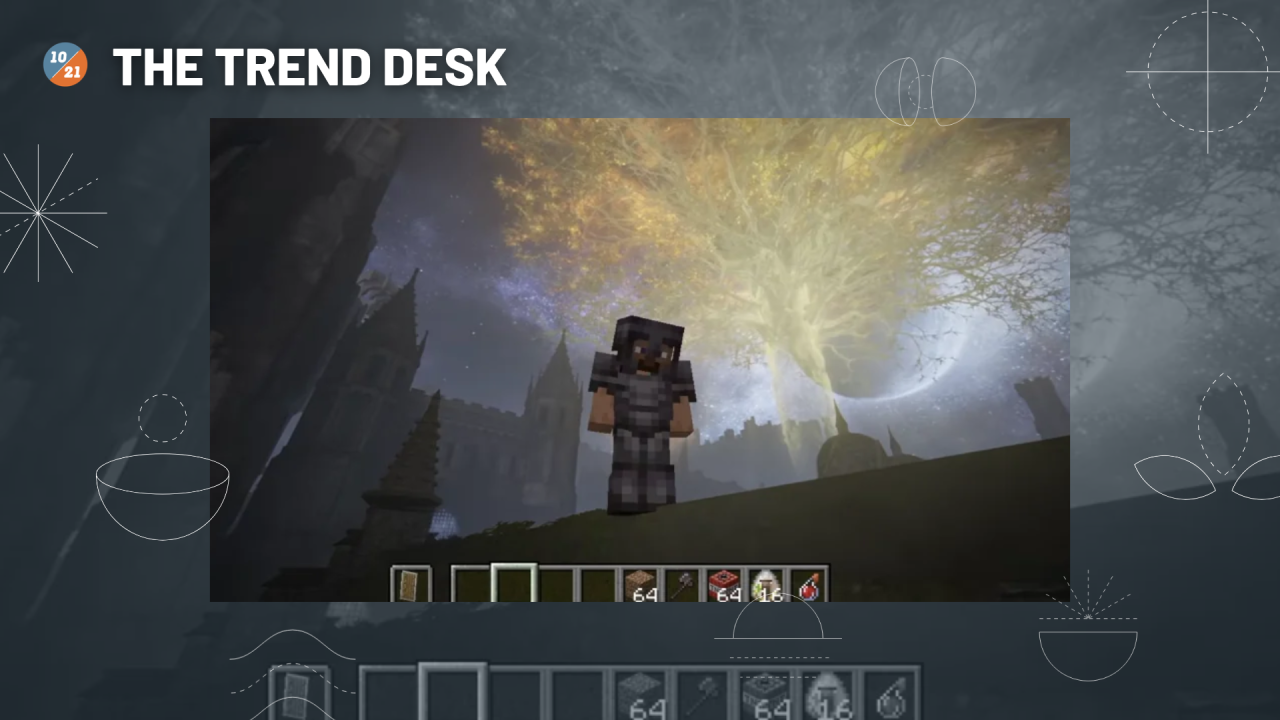
Have you ever wanted to play Minecraft in Elden Ring or swing through Arkham City as Spider-Man instead of the caped crusader himself?
Not a video game fan? How about having access to an entirely free dupe of the Adobe Creative Suite?
Vibe coding and reverse-engineering LLMs are providing programmers everywhere with the tools to make this a reality. But what opportunities does this present?
Are these tools moving too fast for regulation and a true understanding of what this all means to catch up?
What is vibe coding?
Vibe coding is a method of software development where programmers build an app or website by simply describing the features and concepts, letting AI build the source code. The programmer is less worried about the code itself and is just fine tuning the details, testing the results and guiding changes through conversational follow-up prompts.
Vibe coding has been happening for quite some time. Canva Code, Bolt, and Base 44 are vibe-coding tools that already existed before this recent wave in gaming.
However, the latest advances in AI technology have brought a lower barrier to entry for beginner developers, with the caveat that many feel vibe-coded projects are of lesser quality and present security vulnerabilities and high risks. The method has been merged with reverse-engineering LLMs due to recent advancements allowing the process to take less time and use less memory.
Reverse-engineering LLMs excel at pattern recognition, and, with the right amount of memory, are able to churn out video game decompilations and software replication at an alarming rate.
Traditionally in the retro gaming and game preservation communities, you have to decompile a game by working backward from machine code to turn it into a human-readable one. This process can take years, with fan decompiling projects for Super Mario 64 taking two years and The Legend of Zelda: Majora's Mask taking three years. But not any more…
How are people responding? (What’s the vibe?)
Opinions within these gaming communities are mixed. Many hobbyists embrace AI, as it helps them to accomplish projects that otherwise would take years to complete. Currently, most still complete the work themselves but have the AI get them to the finish line, as seen with the recompilation project for Super Smash Bros Melee.
Others say that the hobby of game preservation was born out of amateur programmers and gamers willing to work together and debug kinks. Many of these AI-generated decompilations will require more work to bring them up to the standards of the original game. This has led to major fan decompile sites like decomp.dev to shut down, citing that “‘Slop’ comes in many forms, is hard to define, and even harder to moderate … I don't have the energy (or desire) to define what makes a ‘good’ decompilation … .”
It's no wonder that one of the biggest digital hobbies is seeing the impact of this technology first, especially with growing frustrations around physical vs. digital ownership of games.
This wave of mods, emulators, and decompilations lie in the wake of Sony's July announcement to stop producing physical game discs for all new PlayStation releases starting in January 2028. Many gamers see this as a betrayal that lands a significant blow against the second-hand games market and game sharing. Sony’s response, in poor taste, was that gamers don’t really own their own games when they buy digitally anyway - they’re just renting a license.
Understandably, many saw the complete deconstruction and recreation of the PlayStation 5 operating system and many of its titles on PC through vibe coding with a sense of karmic justice…
And the wider industry is responding. Just look at some of the many related news items within the past few weeks:
- Epic Games released a newly designed launcher in early October, saying that “programming is hard” in a post on their blog, revealing that the new platform was vibe-coded.
- Xbox followed up with plans for a lab focused on experimenting with AI-powered game decompilation, code recompilation, and cross-platform porting.
- Applications like the Adobe and Microsoft Suites have been reverse-engineered to be free and open-source.
- Fed up with ads and bloatware on your smart TV? People are vibecoding ways to remove them
- Google Play is adding a separate personal app library to access any vibe-coded Android apps.
- A small business owner used Claude Code to build SlowBooks Pro, a free replacement for QuickBooks.
Vibe-coding and these reverse LLMs are actively used by indie developers all the way up to major studios, and it presents many legal and ethical questions for us all.
While writing this, someone has already reverse-engineered the infamously gate-kept and proprietary Middle Earth: Shadow of War’s Nemesis System as a mod inside Rockstar's Red Dead Redemption 2.
Without heavy regulation in the U.S., we’re currently in a free-for-all state with what this technology can grow to be, while many consumers are more than happy to see the negative effects of copyright be undermined within the industry, whether the studios like it or not.
The Why and the Future
One of the biggest implications of this moment is the growth of the open source movement. Consumers are growing frustrated at subscription fees, with the resulting pivot toward analog media pushing them towards physical ownership over the digital cloud (while it’s still possible).
For many experienced coders and gaming developers, it raises concerns around employment. Does it diminish their experienced skill set or even grow to make their job obsolete? Can this be a tool that aids, and can be used in coordination with, an experienced programmer?
Lastly, there’s the copyright and technical legal side of it. Can these reverse-engineered apps of existing applications be allowed to exist? Will this jump-start more U.S. legislation and regulations on AI? Can you even claim copyright of an AI-generated app?
Established law from Thaler v. Perlmutter, a case the Supreme Court heard early this year, declared that AI is a tool, not an author. Essentially, AI alone is fundamentally incapable of creating a work that is subject to copyright protection. This, however, doesn’t prevent copyright protection from something made with the assistance of AI, just that the creation must be primarily human-made.
As it stands, the law protects code, not functionality (what the program actually does), meaning that you can make a new game by reverse-engineering the same mechanics as Skyrim or software like Adobe, but to avoid any type of infringement, you must create your own characters and graphics or not use any proprietary or patented systems contained within it.
Conclusion
Clearly, this technology is being implemented by independent programmers and companies already, and it's not something to be ignored. With new updates almost daily, it's something that all companies should stay informed about and people should update their knowledge base on.
Perhaps this shift will be the final straw that leads to AI becoming truly regulated. Vibe coding and reverse-engineered software have done what many small creatives have struggled to accomplish. While leaders in the AI field have been happy to amorally plunder the creativity of small creators and digital communities across the internet, it may have taken multi-billion dollar companies feeling the sting for something to finally be done to bring this technology under control.
In a year’s time, we’re almost guaranteed to see a few apps or video games making a cultural impact that were fully created using vibe coding or reverse-engineered LLMs. The question is, by then, what will the gaming landscape itself look like?