The transience of fan theories

November 2, 2026
by
Yusuke Saito
Consider, for a moment, the living room floor.
It’s 11 p.m. It’s an unmemorable Tuesday. You’re 12 years old, sitting on carpet that probably needed to be vacuumed two weeks ago, staring at a black-and-white panel of a comic book where a man with red hair stares down a sea monster. You and your older brother have been screaming at each other for 45 minutes about whether fruit can possess a soul.
Nobody is getting paid for this. No metrics are being generated. There is no ad revenue. In a few decades, you will be on a voice call with your younger brother analyzing an indie video game that feels like David Lynch directed a cartoon, and your 70-year-old father will be leaning over a dining table, waving his hands around, trying to figure out which fictional prince is going to assassinate which other fictional prince on a giant fictional boat.
This is theory-crafting. Humans have been doing it forever. It is completely irrational, it produces zero gross domestic product, and it is wonderful.
Then, optimized feeds came in.
The Hunt for Definitive Answers
In her book “Young People Who Theorize” (“Kōsatsu suru wakamono-tachi” / 『考察する若者たち』), Japanese literary critic Kaho Miyake looked directly at the modern algorithmic and artificial intelligence-driven internet and identified something strange. People weren't just guessing anymore. They were auditing.
- They stopped asking what a story meant to them and started hunting for the author's singular, hidden intent, like detectives trying to crack a safe.
- They succumbed to taipa — a Japanese portmanteau for “time-performance” and the reason for the creeping anxiety that spending 40 minutes watching a television show might result in an ambiguous ending, leaving their personal time ledger in the red.
- They didn't do it because the algorithms tricked them. The platforms simply built an absurdly fast, frictionless highway for a desire that was already sitting there: the desire to know, right now, that you did not waste your Tuesday.
Millions of people tuned into “Vivant” in Japan and took notes. Millions of people opened threads about “Severance” in the United States and built spreadsheets.
And sometimes, the stories looked back at the spreadsheets.
When the BBC made “Sherlock”, the showrunners noticed that the entire internet was trying to outsmart them. So, they tried to outsmart the internet back. Instead of building a story, they built a meta-textual prank, spending screen time poking fun at the very fandom that cared enough to guess in the first place. (As ScreenRant critic Adrienne Tyler observed “... what it did was make fun of the fandom and their many theories.”)
They forgot what people like Yoshihiro Togashi and Hirohiko Araki (manga authors of “Hunter x Hunter” and “JoJo’s Bizarre Adventure”, respectively) already figured out: stories aren't math equations. Togashi will sit down to write and discover, to his own bewilderment, that his characters have decided to walk out of the room and do something else entirely. This is neither new nor specific to manga.
Late in life, Brazilian novelist Clarice Lispector admitted that her final protagonist, Macabéa, completely wore her out. Macabéa refused to listen. “The person does exist,” Lispector said. “She orders me around a lot.” Lispector could only follow where this stubborn presence led rather than controlling the narrative directly.
If the person holding the pen doesn't know the exact answer, how on earth could you?
In the afterword of Kaho Miyake’s analysis on theorizing youths, Miyake offers a piece of advice that feels almost revolutionary in its uselessness: stay up late.
Waste your time. Do something that will actively ruin your productivity tomorrow morning at 8 a.m., simply because you could not stop thinking about it. When you stay awake until 2 a.m. arguing about fictional kingdoms with people you love or by yourself, you are committing an act of defiance against the spreadsheet.
Narratives Between the Lines
Over a century ago, readers crowded London cafés to dissect “The Strand Magazine”, swapping theories about Sherlock Holmes over tea while Arthur Conan Doyle watched from a nearby table. That impulse migrated onto the internet. Online spaces are chaotic, and fandoms have a notorious habit of taking themselves too seriously — heed that warning before you wade into the comments. But the web is also one of the few places left where you’re allowed to care about fictional people with unapologetic, full-throated sincerity.
So, if there is an ongoing story living in your head right now, don’t let it sit there.
Enter the arena. Write messy fan fiction. Record the 20-minute video essay with three views. Post the unhinged 30-part theory thread no platform metric asked for.
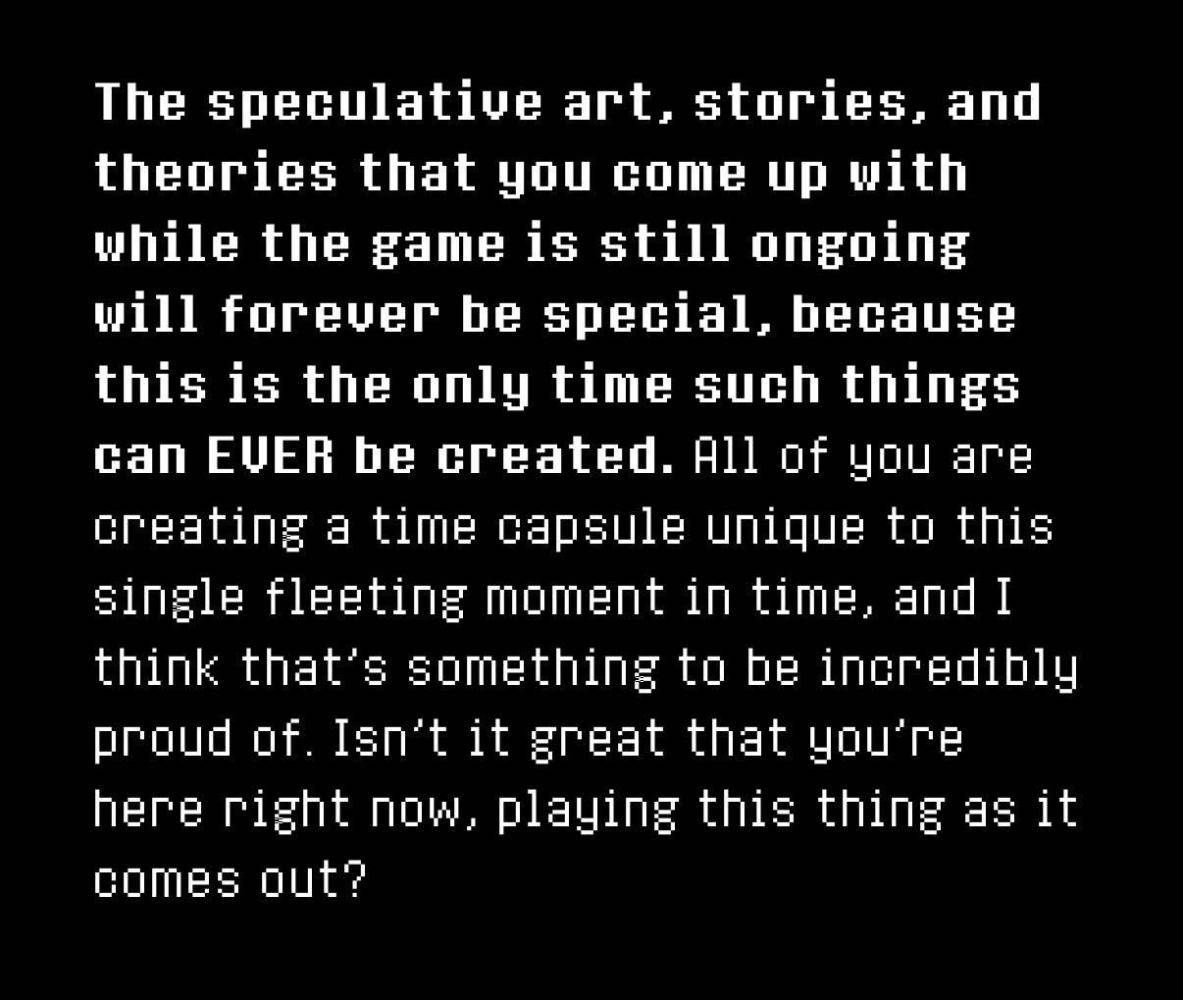
Because in a summer 2026 newsletter, Toby Fox — a guy who makes games about skeletons and choices — reminded us why this matters. All the wild, unhinged fan theories floating around right now are a fleeting “time capsule.” Once the final chapter drops, the canon sets like wet cement. The mystery dies. You never get to guess the same way again.
We are not building these theories because we want to reach the end of the tape. We are building them because, for a little while, the show isn't over yet, and we are still in the room together.